Traditional portfolio diversification has long centered on balancing stocks and bonds, but high-net-worth investors and their advisors are increasingly looking beyond public markets for additional sources of income, return and diversification.
Alternative investments can provide another layer of portfolio construction by introducing assets whose performance may be driven by factors different from those affecting publicly traded stocks and bonds. While the alternatives universe encompasses everything from private equity and hedge funds to collectibles and infrastructure, private credit and income-producing real estate have emerged as two particularly relevant categories for investors seeking income alongside diversification.
Private credit has grown significantly as non-bank lenders have expanded into areas once dominated by traditional financial institutions. The private credit market was estimated at approximately $1.5 trillion at the beginning of 2025, up from roughly $1 trillion in 2020, according to figures cited by Kaufman Rossin Wealth President Jay Pelham in the South Florida Business Journal. The market is projected to reach approximately $2.6 trillion by the end of 2029.
For investors, private credit can offer an income component that differs from traditional fixed-income investments. Private lenders generally raise capital from investors and make loans directly to businesses, earning interest from borrowers and distributing income after fund expenses. Historical industry benchmark data cited by Pelham places gross private credit returns in the 8% to 10% range, although returns vary considerably by strategy, manager, credit quality and market environment.
Private real estate offers another avenue for diversification and income. Rather than purchasing and managing individual properties, investors can gain exposure through professionally managed funds that hold portfolios of properties across markets, sectors and tenants.
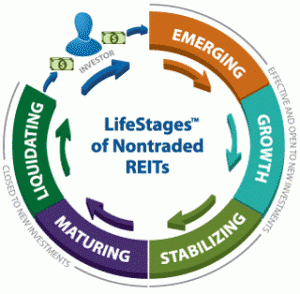
Nontraded REITs are one structure providing that access. Because these vehicles can own numerous properties and property types, investors can potentially obtain broader real estate exposure than they could through the direct ownership of a single commercial or residential property. Professionally managed real estate funds also eliminate many of the operational responsibilities associated with owning investment properties directly.
Certain real estate investment structures may also provide tax characteristics that affect an investor’s after-tax income. Distributions from a REIT, for example, can include return of capital depending on the fund’s operations and tax treatment. Investors and advisors therefore need to consider not only a fund’s stated distribution rate but also the sources and tax treatment of those distributions.
The broader trend illustrates how the definition of diversification is evolving. For investors who historically relied almost exclusively on publicly traded stocks and bonds, private-market investments can introduce additional sources of income and return. Private credit and real estate, in particular, have become increasingly accessible through structures designed for individual investors.
However, alternatives introduce their own considerations, including liquidity limitations, fees, valuation practices, leverage and manager selection. An allocation that reduces exposure to public-market volatility does not eliminate investment risk, making due diligence and appropriate portfolio sizing important parts of the allocation decision.
For wealth advisors, the expanding menu of alternative investment products creates both opportunity and responsibility. Understanding how private-market investments behave alongside traditional assets — and how their liquidity, income, risk and tax characteristics fit a client’s objectives — is becoming an increasingly important part of portfolio construction.