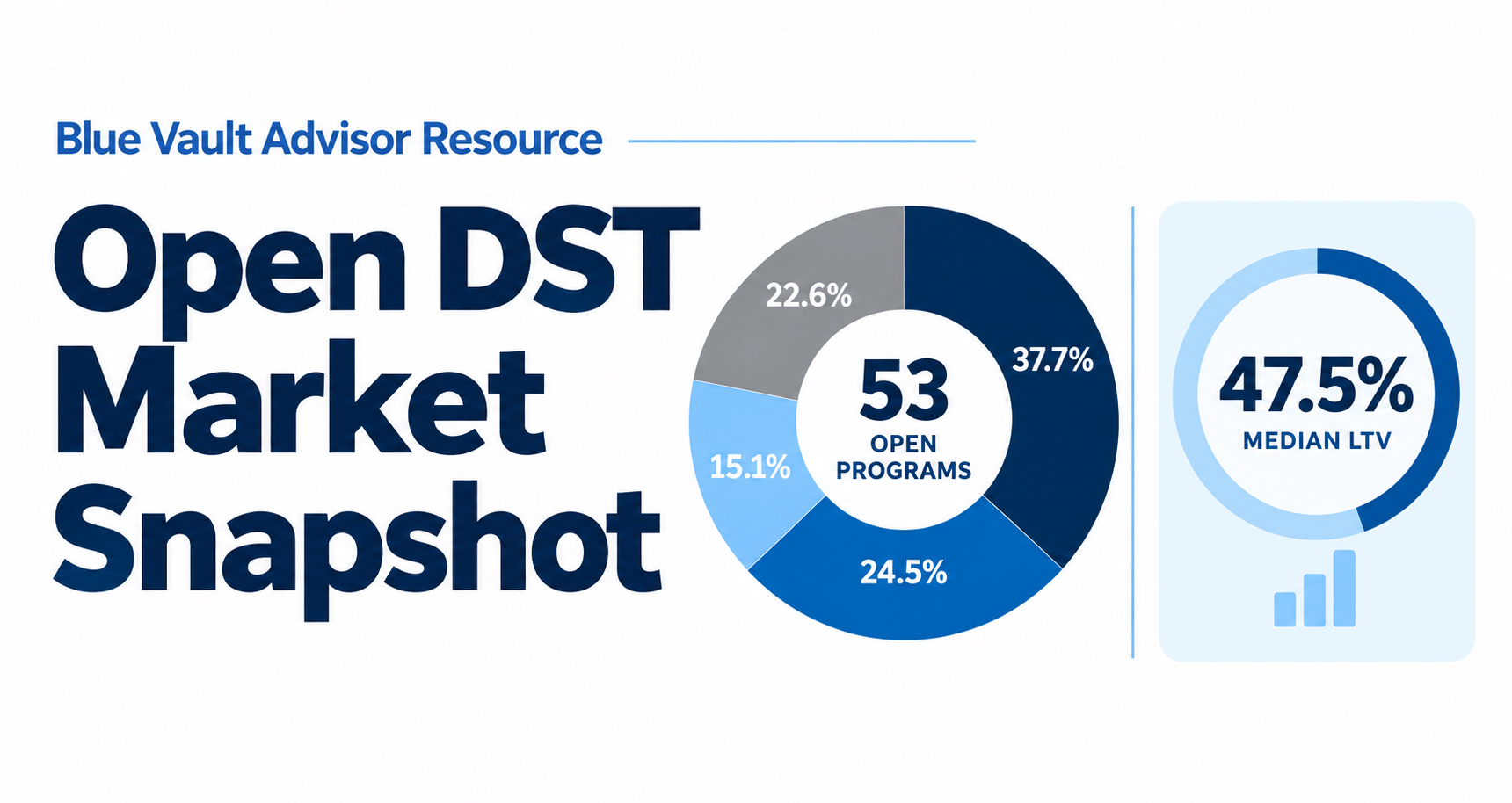
For investors entering a Delaware statutory trust as part of a 1031 exchange, much of the initial due diligence naturally centers on the property, sponsor, financing, projected distributions, and anticipated holding period. But recent research suggests advisors may also want to spend more time considering another question: How could the investment eventually end?
An analysis by Top1031 of SEC filings and other public records covering 1,738 securitized 1031 DST offerings found that dated terminal exits among mature DST cohorts occurred after a median 6.4 years. More significantly, property sales are no longer the only common outcome. Among 143 dated DST outcomes during 2024 through September 8, 2026, 57% were property sales, 20% were Section 721 REIT conversions, and 15% involved foreclosure or documented distress. Looking only at 42 dated 2026 exit events through September 8, the analysis identified 16 property sales, nine Section 721 conversions, and 10 foreclosure or distressed outcomes, with the remaining events involving partial sales or unresolved outcomes.
Those paths can lead to very different results for investors. A conventional property sale may allow an investor to receive proceeds and potentially complete another 1031 exchange, assuming all applicable requirements are met. In a Section 721 transaction, the real estate may instead be contributed to a REIT operating partnership in exchange for operating partnership units. That can provide continued tax deferral and potentially greater portfolio diversification, but the resulting partnership units are not like-kind real property eligible for another 1031 exchange. A distressed outcome presents a different set of considerations, potentially including impairment of investor capital.
The findings do not mean that these outcomes occur with the same frequency across every sponsor or DST, and the underlying research relies on SEC filings, sponsor disclosures, and reconstructed public records rather than comprehensive sponsor-reported industry data. Still, the changing exit mix highlights an important due-diligence consideration. Advisors evaluating a DST may want to understand not only the projected holding period but whether the offering documents contemplate a Section 721 transaction, who controls that decision, what happens when debt matures, and what alternatives may exist if market conditions make a conventional property sale unattractive. For a long-term, illiquid investment, the exit strategy can be nearly as important as the property investors are buying on day one.
Sources
- Top1031, The Top1031 DST Census — 2026 Edition, updated September 9, 2026.
- Top1031, DST Barometer Q2 2026, updated September 2026.
- Top1031, DST Hold vs. 721 UPREIT Conversion: What the Offering Documents Decide, September 5, 2026.