Property type, distribution rate, leverage and sponsor experience often receive the most attention during DST due diligence.
But there is another question worth asking: What could the investor own—or be asked to consider—when the investment reaches its exit?
Seeing “721” should begin the advisor’s next set of questions—not end them.
Blue Vault’s September 21, 2026 data provides a snapshot of how the current open-DST market describes potential exit paths.
What the Current Open-DST Market Shows
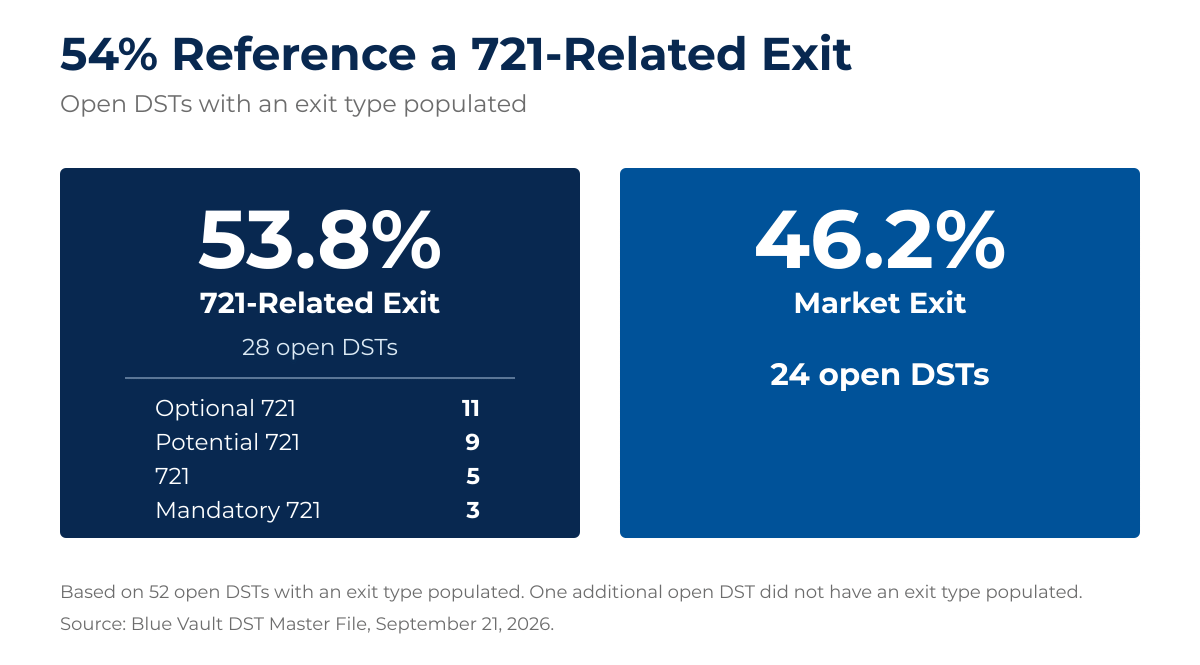
Blue Vault identified 53 open DSTs in the dataset. An exit type was populated for 52 of those programs.
Of the 52 programs with a populated exit type:
- 28 programs, or 53.8%, reference a 721-related exit.
- 24 programs, or 46.2%, identify a market exit.
The 28 programs referencing a 721-related exit span four classifications:
- Optional 721: 11 programs
- Potential 721: 9 programs
- 721: 5 programs
- Mandatory 721: 3 programs
Why the Classification Matters
The 53.8% does not represent one uniform exit structure. Blue Vault’s data shows that the current market uses several different 721-related classifications.
Those classifications should not automatically be treated as equivalent. Advisors should review the applicable offering documents to understand how the potential exit is described and what the classification means for the specific offering.
The data does not establish that one exit type is safer, better or more appropriate. It does show why advisors should investigate the exact exit provisions before treating one 721-related opportunity as comparable with another.
Questions Worth Asking
- Is the 721-related transaction required, optional or only one possible outcome?
- Who determines whether and when the transaction occurs?
- What could the investor receive through the transaction?
- Would the investor continue to own an interest tied to real estate?
- What voting, transfer, redemption or liquidity rights could apply?
- What happens if the anticipated transaction does not occur?
Historical Context From Closed DSTs
Blue Vault’s closed-DST data provides another layer of historical context. Of the 452 closed DST programs reviewed under Blue Vault’s methodology:
356 programs, or 78.8%, are identified as performing.
96 programs, or 21.2%, are identified as underperforming.
For this analysis, a closed DST is identified as underperforming when its actual distribution rate is below its projected distribution rate.
IMPORTANT: THIS IS NOT A TOTAL-RETURN MEASURE
The performing and underperforming classifications compare actual distribution rates with projected distribution rates. They do not indicate that investors experienced a gain or loss, and they do not measure total return or the program’s eventual full-cycle outcome.
Historical results do not determine how a current offering will perform. They can, however, provide advisors with another useful layer of due diligence when evaluating sponsor history and considering potential exit outcomes.
Why This Matters for Advisors
The real intelligence is not simply that 721 appears frequently.
An advisor evaluating a DST may need to examine two stages of the investment: what the investor owns going in and what the proposed exit could look like coming out.
Blue Vault’s data shows that seeing “721” in an offering does not fully answer the exit question. There are multiple classifications in the current market, giving advisors a reason to investigate the specific exit provisions rather than treating every 721 reference as equivalent.
The DST market may increasingly require a two-stage due-diligence process: understand the investment going in—and understand the potential exit coming out.
Bring Exit Provisions Into the Initial Review
Blue Vault’s DST Exit Due-Diligence Checklist provides a focused set of questions advisors can use to examine an offering’s stated exit path, potential 721-related outcome, investor ownership, timing, control, liquidity and tax considerations.
DOWNLOAD THE DST EXIT DUE-DILIGENCE CHECKLIST
Continue the Analysis in Blue Vault
Compare DST exit classifications alongside other offering data in the Blue Vault platform. Advisors can use the DST section to examine current programs, offering details, sponsor history and full-cycle outcomes.
Already Have Blue Vault Access?
Log in to continue your research.
Not Yet Registered?
Financial advisors can access Blue Vault at no cost.
Source & Methodology
- Open-DST figures are based on the Blue Vault DST Master File as of September 21, 2026.
- Blue Vault identified 53 open DSTs. Exit type was populated for 52 programs; one program did not have an exit type populated.
- The 721-related total combines programs classified as Optional 721, Potential 721, 721 and Mandatory 721.
- Blue Vault DST data is compiled from sponsor-issued source materials available to Blue Vault, including offering, closing, disposition and other sponsor-provided reporting. Blue Vault does not independently audit sponsor-reported information.
- For the closed-DST analysis, a program is identified as underperforming when its actual distribution rate is below its projected distribution rate. This classification does not indicate total return, investor loss or the eventual full-cycle outcome.
- Historical results are for informational purposes only and are not indicative of future performance. Blue Vault does not provide investment, tax or legal advice.
References to Section 721 and 721-related exit classifications are provided for informational purposes only. A 721-related exit is not guaranteed to occur. Review the applicable offering documents and consult appropriate tax, legal and investment professionals.