AltsTech News
AltsTech News
KBS Eyes Raising $105Mln for Private REIT
Friday, 04 September 2015 Commercial Real Estate Direct Staff Report KBS Realty Advisors, an...
Downtown SJ Towers to Ssell in $150 Million Deal
Nathan Donato-Weinstein Real Estate Reporter Silicon Valley Business Journal Sep 4, 2015, 6:21pm...
With Backing From the Blackstone Group, This Bank Is a Turnaround Worth Watching
With loads of capital and a surge in new deals, this bank has caught the attention of several...
Capitalization Rates Defined – Part I
REIT investors may have seen the term “capitalization rate” used in discussions of individual real estate property acquisitions and valuations and even in the broader market context when comparing investor expectations and property portfolio values. In this article we explain what capitalization rates or “cap rates” are and what they aren’t, and how nontraded REIT investors might interpret them. Investors expect both a return on their investment and a return of their investment. Both types of returns involve risk. Rational investors realize that higher expected returns involve more risk, which may mean less predictable returns or greater chance of loss.
Investing in Alternative Investments – by NorthStar Securities
Content Submitted by NorthStar Securities – Alternative investments refer to nontraditional...
ARC Hospitality Trust Turns Over 13 Hotels for Crestline to Manage
ARC Hospitality Trust Turns Over 13 Hotels for Crestline to Manage By Erika Morphy | Washington,...
Diversify Income with a Real Estate Investment Trust
Content Submitted by Black Creek Group (formerly Dividend Capital Group) – It’s been...
Larry Roth Steps Down From RCAP Board After Four Months
Company says he is focusing on his role as CEO of Cetera Financial Group Sep 1, 2015 @ 11:10 am By...
CNL Financial Group Hires Vice President for CNL Securities
Scott Belval will serve as Vice President of Sales. Orlando, Fla., Sept. 1, 2015 (GLOBE NEWSWIRE)...
Inland Residential Properties to Buy Luxury Frederick Apartment for $46M
By Erika Morphy | Washington, DC The Haven at Market Square FREDERICK, MD—Inland Residential...
How do nontraded REITs make money?
It’s important to note that operationally, nontraded REITs have a lot in common with publicly traded REITs.
Nontraded REIT Industry Review Q1 2015
Click to download: Nontraded REIT Industry Review Q1 2015...
Blue Vault Explains Liquidity Options For Non-Traded REIT Holders
The DI Wire Non-traded REITs are illiquid investments designed for the long-term investor seeking...
Moody National REIT I, Inc. To Acquire $1.725 Billion Portfolio
PR Newswire HOUSTON, May 21, 2015 /PRNewswire/ — Moody National REIT I, Inc. (the...
What is a Business Development Company?
A business development company (BDC) is an SEC-registered investment company that invests in primarily private U.S.-based businesses. This form of company was created by Congress in 1980 as amendments to the Investment Company Act of 1940. BDCs are typically taxed as regulated investment companies (RICs). Similar to REITs, BDCs are required to distribute at least 90% of taxable income as dividends to investors, and the company itself pays little or no corporate income tax.
Investment Timing and Performance in Full-Cycle Nontraded REITs
Many investment professionals assume that it is better to invest in nontraded REITS later in their fundraising period rather than earlier. The recent study of full-cycle events by nontraded REITs performed by Blue Vault and the University of Texas McCombs School of Business The University of Texas at Austin, casts doubt on that assumption.
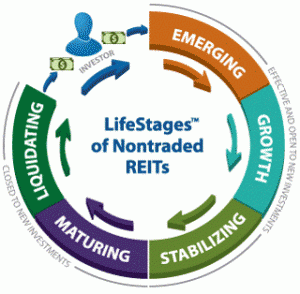
The LifeStages™ Classification System—Using Meaningful Metrics to Compare Nontraded REITs
When recommending and choosing nontraded REITs for their clients, most advisors know the importance of looking at key metrics such as debt, distribution yield, MFFO payout ratios, and portfolio diversification. However, these metrics may vary greatly from REIT to REIT depending on where each program is in its life cycle.
Timing and Selection in the Performance of Full-Cycle Nontraded REITs
In the recent study prepared in collaboration with The University of Texas called, “Nontraded REIT Industry Full-Cycle Performance Study” in addition to analyzing the total returns of the 17 nontraded REITs that went full-cycle between 1990 and March 2012, the findings also provided insights into what we might call “Timing versus Selection.”
Secondary Markets
Shareholders in nontraded REITs have limited options when attempting to liquidate some or all of their common stock holdings. While most nontraded REITs have share redemption programs, these programs may have been suspended due to liquidity issues or restricted to redemption requests filed due to death, disability or other hardships. Blue Vault reports on the redemptions of nontraded REIT shares by each REIT on a quarterly basis, but a more complete picture of the redemptions issue would require a comparison of redemptions request to redemptions granted. For example, CNL Lifestyle REIT redeemed 319,000 shares of the 9,726,000 pending redemption requests in 3Q 2012. Behringer Harvard REIT I redeemed 880,000 shares (0.3%) of the 299 million shares outstanding in 2012. KBS REIT I imposed a $10 million limit on redemptions for all of 2012 and redeemed 1.38 million shares (0.7%) of the 191.1 million shares outstanding at an average price of $5.58 per share.
Why Invest in a REIT?
There are a number of reasons to invest in REITs. The following are some of the main...